
Basic Strategy Chart for Online Blackjack
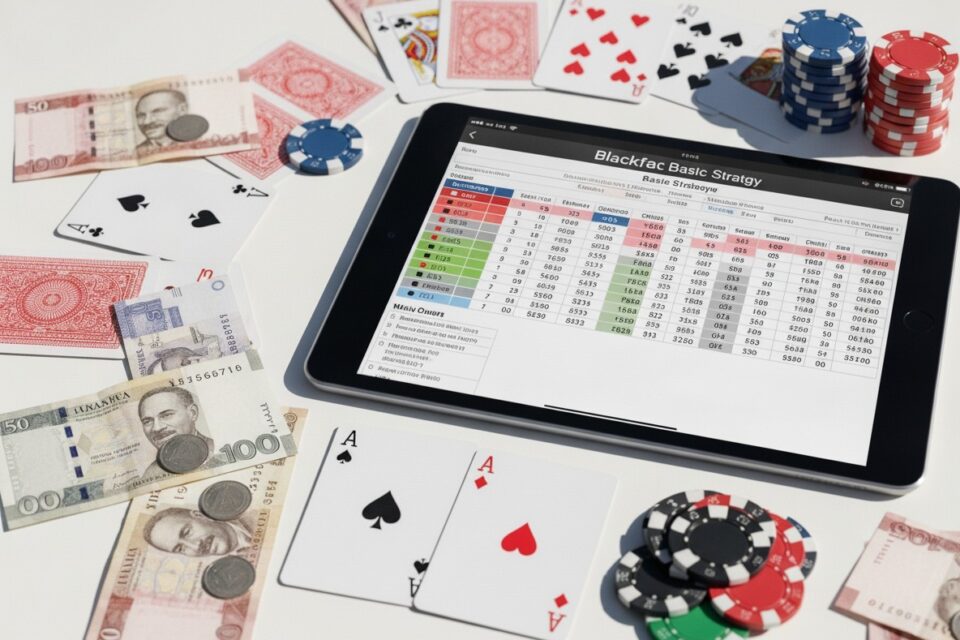
Basic strategy represents the mathematically optimal decision framework for every possible blackjack hand combination, designed to minimize the house edge through probability-based choices rather than intuition or guesswork. For Ghana players enjoying online blackjack on mobile devices or desktop platforms, understanding and applying basic strategy charts can dramatically improve long-term results by eliminating costly emotional decisions and gut feelings that typically favor the casino.
This comprehensive guide covers the essential components of blackjack basic strategy charts, including hard totals, soft totals, and pair splitting decisions tailored to the rule variations commonly found at licensed online casinos serving Ghanaian players. Before relying on any strategy chart, players must verify specific game rules such as dealer behavior on soft 17, payout rates, and splitting restrictions, as these factors directly influence optimal play decisions and chart accuracy.
What Basic Strategy Means for Online Blackjack in Ghana
Basic strategy functions as a probability-based system that provides the statistically best decision for every blackjack scenario, though it never guarantees individual wins or eliminates the inherent house edge completely. The system relies on mathematical calculations that consider millions of hand simulations to determine whether hitting, standing, doubling, or splitting produces the highest expected value over time. Understanding that basic strategy reduces rather than eliminates losses helps Ghana players maintain realistic expectations while benefiting from improved decision-making.
Chart recommendations change significantly based on specific rule variations such as whether dealers stand or hit on soft 17, surrender options, doubling restrictions, and blackjack payout rates. A strategy chart optimized for games with 3:2 blackjack payouts differs from charts designed for 6:5 games, while surrender availability creates additional strategic options that affect multiple decisions throughout the chart. Ghana players must match their chosen chart to the exact rules of their preferred online blackjack variant.
Rule variations commonly encountered at online casinos can shift optimal strategy enough to impact long-term profitability, making rule verification essential before chart application. Different charts exist for single-deck, double-deck, and multi-deck games, while some online platforms offer unique rule combinations that require specialized strategy adjustments. Mobile blackjack apps popular in Ghana often feature standardized rules, but live dealer blackjack may present different conditions that affect chart selection.
Why basic strategy matters more than intuition
Intuitive decision-making in blackjack typically leads to costly mistakes such as chasing hot or cold streaks, standing on weak totals against strong dealer upcards, or hitting hands that should be doubled for maximum value. Human psychology naturally gravitates toward pattern recognition and emotional responses that prove counterproductive in a game governed by mathematical probabilities. Basic strategy eliminates these psychological pitfalls by providing concrete, tested decisions for every situation.
Following basic strategy consistently reduces the house edge to approximately 0.5% in favorable rule conditions, compared to 2-5% for players relying on intuition or flawed strategies like always mimicking the dealer. This difference translates to significantly improved long-term results, especially for Ghana players who enjoy regular online blackjack sessions. The cumulative effect of making optimal decisions compounds over time, turning what might be rapid losses into extended, entertaining gameplay.
Which online blackjack rules affect the chart
Deck number represents one of the most significant factors affecting basic strategy, with single-deck games requiring different decisions for certain hands compared to six or eight-deck shoes commonly used online. The S17 rule, where dealers stand on soft 17, generally favors players compared to H17 games where dealers hit soft 17, creating subtle but important strategy adjustments throughout the chart. Surrender availability, particularly early surrender, dramatically alters optimal play for several weak hands against strong dealer upcards.
Doubling restrictions such as “double on 9, 10, 11 only” or “no doubling after splitting” eliminate strategic options that basic strategy charts assume are available, requiring players to revert to secondary options like hitting instead of doubling. Payout rates for blackjack hands directly impact the mathematics underlying strategy decisions, with 6:5 games requiring more conservative play in marginal situations compared to standard 3:2 games. Some online platforms also limit resplitting or restrict splitting certain pairs, affecting pair-based decisions.
Ghana players should always verify game rules before starting play, as online casinos may offer multiple blackjack variants with different rule combinations on the same platform. Checking the game’s help section or rule summary ensures that the chosen basic strategy chart matches the actual playing conditions. Live dealer blackjack often features the most player-friendly rules, while some RNG-based games may include unfavorable conditions that require adjusted strategies.
How to Read a Blackjack Strategy Chart
Blackjack strategy charts organize optimal decisions using a grid format where player hands appear on vertical rows and dealer upcards span horizontal columns, creating an intersection point that indicates the mathematically best action for each scenario. The chart divides player hands into three distinct categories: hard totals (hands without aces or aces counted as 1), soft totals (hands with aces counted as 11), and pairs (identical cards that can potentially be split). Understanding these categories helps Ghana players quickly locate the correct section for their specific hand.
Dealer upcards ranging from 2 through Ace guide the decision matrix, with weak upcards (2-6) generally favoring more conservative player actions while strong upcards (7-Ace) often require more aggressive play to compete effectively. The intersection of player hand and dealer upcard reveals action abbreviations such as H for hit, S for stand, D for double (or hit if doubling isn’t allowed), P for split, and occasionally R for surrender in games where this option exists.
| Chart element | Meaning | How to use it |
|---|---|---|
| Vertical rows | Your hand total or pair type | Find your hand value on the left side |
| Horizontal columns | Dealer’s visible upcard | Locate dealer’s upcard across the top |
| H | Hit – take another card | Request additional card from dealer |
| S | Stand – keep current total | End your turn with current hand value |
| D | Double – double bet, take one card | Double wager and receive exactly one card |
| P | Split – separate pair into two hands | Create two hands with matching bet amounts |
Chart layout and hand categories
Hard totals include any hand where aces count as 1 or hands without aces, such as 10-6 for hard 16 or A-5-10 for hard 16. Soft totals contain at least one ace counted as 11, like A-7 for soft 18, providing flexibility since the ace can revert to a value of 1 if hitting would cause a bust. Pairs consist of identically ranked cards such as 8-8 or K-Q, though only true pairs like 8-8 can be split while different ten-value cards cannot.
Dealer upcards create the strategic framework that determines optimal player actions, with weak dealer cards (2-6) indicating higher bust probability and strong cards (7-A) representing greater dealer strength. The decision matrix uses this dealer information combined with player hand strength to recommend the action that produces the highest mathematical expectation over millions of simulated hands.
Hard Totals: Best Plays by Dealer Upcard
Hard totals represent the most frequently encountered blackjack hands and form the foundation of basic strategy decision-making, covering player totals from 8 through 17 and higher with specific actions determined by dealer upcard strength. These decisions focus on three primary actions: hitting to improve weak totals, standing to avoid busting strong totals, and doubling to maximize value in favorable situations. Understanding hard total strategy provides the essential framework for successful blackjack play.
The strategy for hard totals balances the risk of busting against the probability of dealer weakness, with decisions shifting dramatically based on whether the dealer shows weak cards (2-6) or strong cards (7-Ace). Against weak dealer upcards, players can afford more conservative play since the dealer faces higher bust probability, while strong dealer upcards require more aggressive player actions to compete effectively.
Key decision points include knowing when to stand on marginal totals like 12-16 against weak dealer cards versus when to hit these same totals against strong dealer cards. Doubling opportunities on totals like 9, 10, and 11 require careful consideration of both player hand strength and dealer upcard, as doubling increases both potential wins and losses by requiring exactly one additional card.
| Player hard total | Versus weak dealer cards (2-6) | Versus strong dealer cards (7-A) | Typical action |
|---|---|---|---|
| 8 | Hit | Hit | Always hit weak total |
| 9 | Double vs 3-6 | Hit | Double in favorable spots |
| 10 | Double | Double vs 7-9, Hit vs 10-A | Strong doubling hand |
| 11 | Double | Double vs 7-10, Hit vs A | Best doubling opportunity |
| 12 | Stand vs 4-6 | Hit | Marginal decision hand |
| 13-16 | Stand | Hit | Dealer dependency |
| 17+ | Stand | Stand | Always stand |
When to hit or stand with hard totals
Standing on strong totals of 17 and higher represents the most straightforward decision in blackjack, as hitting these hands creates excessive bust risk that outweighs potential improvement. However, totals of 12-16 create complex decisions that depend heavily on dealer upcard strength, with players generally standing against weak dealer cards (4-6) and hitting against strong dealer cards (7-Ace). The classic example of hard 16 versus dealer 10 illustrates this principle, where hitting offers better long-term expectation despite high bust risk.
The decision to hit 12 against dealer 2 or 3 demonstrates how basic strategy sometimes contradicts intuitive play, as these scenarios favor hitting despite the dealer showing apparently weak cards. Mathematical analysis reveals that the dealer’s relatively low bust probability with these upcards makes hitting the superior choice. Hard 12 against dealer 4-6 represents the opposite scenario, where standing becomes optimal due to increased dealer bust probability.
When to double with hard totals
Doubling on hard 11 provides the strongest opportunity in blackjack, as drawing any ten-value card creates an unbeatable 21 while the dealer faces potential weakness with most upcards except Ace. Hard 10 offers the second-best doubling opportunity, though players should hit rather than double against dealer 10 or Ace to minimize risk in unfavorable matchups. These premium doubling hands represent situations where aggressive play maximizes long-term profit.
Hard 9 creates a conditional doubling opportunity primarily against dealer upcards 3-6, where dealer weakness combines with player potential to create favorable doubling conditions. Against stronger dealer cards, hitting becomes preferable to preserve flexibility while avoiding the commitment required by doubling. Rules affecting doubling opportunities, such as restrictions on doubling after splitting or limits on which totals can be doubled, significantly impact these strategies and may require chart adjustments.
Soft Totals and Why the Ace Changes Everything
Soft hands containing an ace counted as 11 provide unique strategic flexibility that distinguishes them from hard totals, as players can draw additional cards without immediate bust risk since the ace can revert from 11 to 1 if necessary. This flexibility allows for more aggressive play compared to equivalent hard totals, creating opportunities to double in situations where hard hands would require conservative hitting or standing. Understanding soft hand strategy helps Ghana players capitalize on these advantageous situations.
The ace’s dual nature fundamentally alters decision-making for totals like soft 18, which many players incorrectly assume should always be stood, when in reality this hand benefits from doubling against weak dealer upcards and hitting against strong ones in certain situations. Soft hands permit aggressive play that would be impossible with hard totals of similar value, making proper soft hand strategy essential for minimizing house edge.
- Soft 13-15 (A,2 through A,4): Always hit against all dealer upcards, as these weak totals require improvement and cannot bust on the next card
- Soft 16-17 (A,5 through A,6): Double against dealer 4-6 when possible, otherwise hit to build toward stronger totals
- Soft 18 (A,7): Double against dealer 3-6, stand against 2,7,8, and hit against 9,10,A for optimal results
- Soft 19-20 (A,8 through A,9): Always stand regardless of dealer upcard, as these strong totals rarely benefit from additional cards
- Soft doubling strategy: More liberal than hard doubling due to reduced bust risk and potential for hand improvement
Core soft-hand decisions
Soft 18 represents the most misunderstood hand in blackjack, as many players automatically stand without considering the dealer upcard and available options. Against weak dealer cards 3-6, doubling maximizes value by leveraging dealer weakness, while standing against moderately strong cards 2, 7, and 8 preserves a decent total. The counterintuitive decision to hit soft 18 against dealer 9, 10, or Ace reflects the mathematical reality that 18 loses more often than it wins against these strong dealer cards.
Soft 16 and 17 create excellent doubling opportunities against dealer bust cards 4-6, as players can improve their totals without bust risk while facing dealers with high bust probability. When doubling isn’t allowed or favorable, hitting becomes the default action for these hands, as standing on soft 16 or 17 represents suboptimal play in virtually all situations. The flexibility of soft hands enables this aggressive approach that hard totals cannot safely employ.
Pair Splitting Rules That Save Money Long-Term
Pair splitting decisions represent some of the most crucial and profitable opportunities in blackjack when executed correctly, as proper splits can convert weak hands into strong ones while maximizing value in favorable situations. The fundamental principle behind splitting involves comparing the expected value of playing the pair as a single hand versus creating two separate hands, with some pairs like Aces and 8s benefiting from splitting in virtually all situations. Understanding which pairs to split and when creates significant long-term value for Ghana players.
Splitting decisions must account for specific table rules such as whether doubling after splitting is allowed, how many times pairs can be resplit, and whether split Aces receive only one card each. These rule variations can dramatically affect the profitability of certain splits and may require strategy adjustments to avoid costly mistakes.
| Pair | Always/usually split? | Common exceptions | Reason |
|---|---|---|---|
| A-A | Always split | No exceptions | Creates two potential blackjacks |
| 8-8 | Always split | No exceptions | Escapes weak 16 total |
| 10-10 | Never split | No exceptions | 20 is excellent hand |
| 9-9 | Usually split | Stand vs 7, 10, A | 18 competitive vs some cards |
| 7-7 | Split vs weak cards | Hit vs 8, 9, 10, A | Dealer strength matters |
| 6-6 | Split vs weak cards | Hit vs 7-A | Avoid weak 12 when possible |
| 5-5 | Never split | Double or hit instead | 10 is premium doubling hand |
| 4-4 | Rarely split | Hit in most situations | 8 total has improvement potential |
| 2-2, 3-3 | Split vs weak cards | Hit vs strong dealer cards | Depends on dealer weakness |
Pairs to split almost always
Splitting Aces provides the most valuable splitting opportunity in blackjack, as each Ace becomes the foundation for a potential blackjack or strong total, converting a mediocre soft 12 into two premium starting hands. Most casinos restrict split Aces to receiving only one additional card each, but this limitation doesn’t diminish the mathematical advantage of splitting in all situations regardless of dealer upcard.
Splitting 8s represents the classic example of defensive splitting, as the combined total of 16 creates the worst possible hand in blackjack while two hands starting with 8 each offer significantly better prospects. Even against strong dealer cards like 9, 10, or Ace, splitting 8s produces better expected value than playing the terrible 16 total as a single hand.
Pairs that depend on dealer upcard
Pairs like 2s, 3s, and 6s create situational splitting opportunities that depend heavily on dealer upcard strength, with splits generally favored against weak dealer cards (2-6) and hitting preferred against strong dealer cards (7-Ace). These marginal pairs benefit from splitting when the dealer faces high bust probability but become liabilities when the dealer shows strength. The ability to double after splitting significantly improves the value of these borderline splits.
Pair 7s follow similar logic, with splitting recommended against dealer 2-7 and hitting preferred against stronger dealer cards 8-Ace. Some online blackjack tables limit resplitting opportunities or prohibit doubling after splits, which can affect the profitability of these marginal splitting decisions. Ghana players should verify these rules before applying standard splitting strategy, as restricted tables may require more conservative pair play.
Ghana-Specific Online Blackjack Considerations
Ghana players accessing online blackjack through mobile devices and international casino platforms face unique considerations regarding game selection, rule verification, and payment processing that can affect strategy implementation and overall gaming experience. Mobile blackjack apps often feature streamlined interfaces that may obscure important rule details, making it essential to thoroughly investigate game conditions before committing to play. Understanding local regulations and choosing properly licensed operators ensures both legal compliance and access to fair, regulated gaming.
Payment considerations specific to Ghana include evaluating deposit and withdrawal options that support local banking systems, mobile money services, and international transfer methods commonly used by Ghanaian players. Currency conversion fees and processing times can impact bankroll management strategies, making it important to understand the full cost structure before beginning play.
- Verify game rules and payouts: Check blackjack payout rates (3:2 vs 6:5), dealer behavior on soft 17, surrender availability, and splitting/doubling restrictions before selecting a basic strategy chart
- Test mobile interface functionality: Ensure the mobile platform clearly displays cards, allows sufficient decision time, and provides easy access to game rules and betting controls
- Confirm payment processing options: Verify that deposit and withdrawal methods support Ghanaian banking systems, mobile money, or preferred international payment services
- Understand currency conversion costs: Calculate the total cost impact of playing in foreign currencies, including conversion fees and exchange rate fluctuations
- Review operator licensing and regulation: Choose platforms with proper licensing from recognized gaming authorities to ensure fair play and dispute resolution capabilities
- Assess customer support availability: Confirm that support services operate during Ghanaian hours and offer communication in preferred languages
What to verify before using any chart
Payout rates for blackjack hands represent the most critical rule variation affecting strategy decisions, with 6:5 games requiring significant strategy adjustments compared to standard 3:2 games that most basic strategy charts assume. Deck count also influences optimal play, with single-deck games offering different strategy recommendations for certain hands compared to multi-deck shoes commonly used online. Surrender availability creates additional strategic options that standard charts may not address, requiring specialized charts or strategy modifications.
Table limits and betting rules can affect bankroll management strategies that support consistent chart application, while some online platforms offer side bets or bonus features that alter the basic game structure. Doubling and splitting restrictions vary significantly between online casinos and can invalidate portions of standard strategy charts if not accounted for properly. Live dealer games often provide the most transparent rule disclosure, while some RNG-based variants may feature unusual rule combinations.
Ghana players should specifically verify whether their chosen platform restricts access to certain game variants based on geographic location, as some operators offer different rule sets to different regions. Reading the complete game rules section and testing with small bets helps ensure that the selected basic strategy chart matches actual game conditions before committing larger bankroll portions to play.
Common Mistakes Ghana Players Make With Basic Strategy
Even players who understand basic strategy concepts often fall victim to emotional decision-making that overrides mathematical logic, particularly during losing streaks or when facing seemingly counterintuitive chart recommendations like hitting soft 18 against strong dealer cards. Insurance betting represents one of the most costly mistakes, as this side bet carries a high house edge that erodes long-term results regardless of basic strategy adherence for main hands. Recognizing and avoiding these common errors helps Ghana players maximize the benefits of proper strategy implementation.
Bankroll management failures frequently undermine otherwise solid strategy play, as players who bet beyond their means often abandon basic strategy when facing financial pressure or attempt to chase losses with increasingly aggressive play. Emotional discipline becomes as important as strategic knowledge for achieving consistent results in online blackjack.
- Taking insurance bets: Insurance carries approximately 7% house edge and should be declined regardless of hand strength or dealer upcard
- Chasing hot or cold streaks: Abandoning basic strategy based on recent results ignores the mathematical foundation that makes the system effective
- Playing 6:5 blackjack games: These games increase house edge significantly compared to 3:2 games and require different strategy considerations
- Deviating from chart recommendations: Following hunches or “feeling” instead of proven mathematical decisions increases long-term losses
- Betting progression systems: Attempting to overcome house edge through betting patterns rather than optimal play creates additional risk
- Ignoring bankroll limits: Playing at stakes too high for available bankroll forces suboptimal decisions during inevitable losing periods
Mistakes that increase the house edge
Insurance betting represents perhaps the most expensive single mistake available in blackjack, as this side wager carries a house edge of approximately 7.4% in multi-deck games regardless of the player’s main hand or the specific dealer upcard. Players often rationalize insurance as “protecting” strong hands like 20 against dealer blackjack, but the mathematical reality shows that declining insurance always provides better long-term results. Even players with blackjack should refuse insurance, as the even-money payout offered is mathematically inferior to playing out the hand normally.
Side bets commonly offered in online blackjack variants create additional house edge that cannot be overcome through basic strategy, as these wagers typically carry house advantages ranging from 3% to over 25% depending on the specific bet type. Perfect pairs, 21+3, and other bonus bets may seem appealing but consistently drain bankrolls faster than main-game losses. Emotional deviations from basic strategy, such as standing on 16 against dealer 7 because “it feels safer,” gradually increase the effective house edge and reduce long-term winning potential.
Bankroll habits that support chart play
Effective bankroll management requires setting session limits that allow for normal variance without forcing desperate decisions when basic strategy recommends actions that feel uncomfortable or counterintuitive. A properly sized bankroll for online blackjack should support at least 100-200 maximum bets to weather typical losing streaks without requiring strategy abandonment due to financial pressure. Flat betting strategies work best with basic strategy implementation, as progressive betting systems often create situations where optimal decisions become financially impractical.
Session discipline becomes crucial when facing the inevitable runs of bad luck that affect even perfect strategy play, as players who chase losses by increasing bet sizes or abandoning proven strategies typically compound their problems rather than solving them. Setting specific win and loss limits for each session helps maintain emotional equilibrium and preserves bankroll for future play when conditions may be more favorable. Regular bankroll review and adjustment ensures that betting levels remain appropriate as financial circumstances change.
A Practical Chart-Based Learning Plan
Developing proficiency with basic strategy charts requires systematic study and practice that focuses on the most common decisions first before progressing to more complex scenarios and rule variations. The most effective learning approach involves memorizing core decisions for hard totals 12-16 against various dealer upcards, as these represent the most frequently encountered situations in actual play. Once these fundamental decisions become automatic, players can expand their knowledge to include soft totals, pair splitting, and rule-specific adjustments.
Practice with online blackjack calculators and strategy trainers helps reinforce proper decisions without financial risk, while gradual progression from free games to low-stakes real money play allows for confidence building before committing larger bankroll portions. Regular review and self-testing ensure that learned strategies remain sharp and accurate over time.
| Learning step | Goal | Output |
|---|---|---|
| Master hard totals 12-16 | Learn most common decisions | Automatic hit/stand choices |
| Learn doubling hands 9-11 | Identify value maximizing spots | Confident doubling decisions |
| Study soft hand strategy | Understand ace flexibility | Proper soft total play |
| Memorize pair splitting rules | Optimize pair opportunities | Accurate splitting choices |
| Practice with trainers | Build decision speed | Rapid accurate play |
| Apply in low-stakes games | Real money validation | Confident live application |
| Review and maintain skills | Prevent strategy decay | Consistent long-term results |
How to memorize and apply the chart
Beginning with the most frequently encountered decisions creates an efficient learning path that provides immediate practical benefit, with hard totals 12-16 against dealer upcards 2-6 representing the foundation of basic strategy knowledge. These “stand” decisions against weak dealer cards become easier to remember when players understand the underlying logic of letting the dealer bust rather than risking their own bust. Progressing to hitting these same totals against strong dealer cards 7-Ace completes the core hard total strategy.
Blackjack calculators and online strategy trainers provide valuable practice tools that highlight mistakes immediately and track improvement over time, allowing players to identify weak areas that require additional focus. Starting with single-deck basic strategy often proves easier for initial learning, even if players ultimately intend to play multi-deck games, as the decisions are generally more intuitive and the charts less complex. Regular practice sessions of 15-20 minutes prove more effective than occasional longer study periods for building lasting strategic knowledge.
Real-money application should begin only after achieving consistent accuracy in practice sessions, with low-stakes games providing the ideal environment for building confidence without excessive financial risk. Keeping a simple strategy card reference during initial live play helps maintain accuracy while building familiarity, though players should gradually transition to memorized decisions for optimal playing speed and confidence.